
What we focus on:
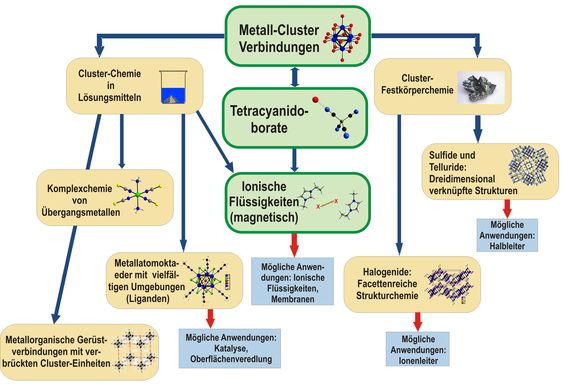
The research activities in our group are geared toward the development of new materials that can be applied usefully in everyday life as well as in industrial applications. We focus on metal-rich compounds of early transition metals, tetracyanidoborate salts, and ionic liquids. Current work focuses on the synthesis, structure elucidation, and determination of physical properties of novel substances, as well as on further developing the understanding of the relationship between the properties and structures of chemical compounds. To this end, methods of classical solid-state chemistry, solution-chemistry-oriented molecular complex chemistry, and theoretical methods of modern quantum mechanics are employed.
Our laboratories
Our laboratory is unique and distinguishes itself from other research groups through larger-scale apparatus and specialized equipment. This includes a dedicated fume hood for glassblowing, enabling us to design custom components tailored to our specific reactions. This workstation is equipped with a hydrogen-oxygen burner and a gas-oxygen burner, allowing for the manipulation of quartz glass. Furthermore, a welding apparatus facilitates the handling of metal ampoules used for reaction mixtures. Another critical component is our high-vacuum system, which can achieve a vacuum down to 10-6 mbar. An electric arc furnace capable of reaching temperatures up to 6000 °C further allows for the reaction of highly refractory materials within a melt. Additionally, we are equipped with a glovebox that streamlines the handling of air- and moisture-sensitive materials, as well as a microscope for the characterization of the synthesized crystals.
Metal atom cluster compounds
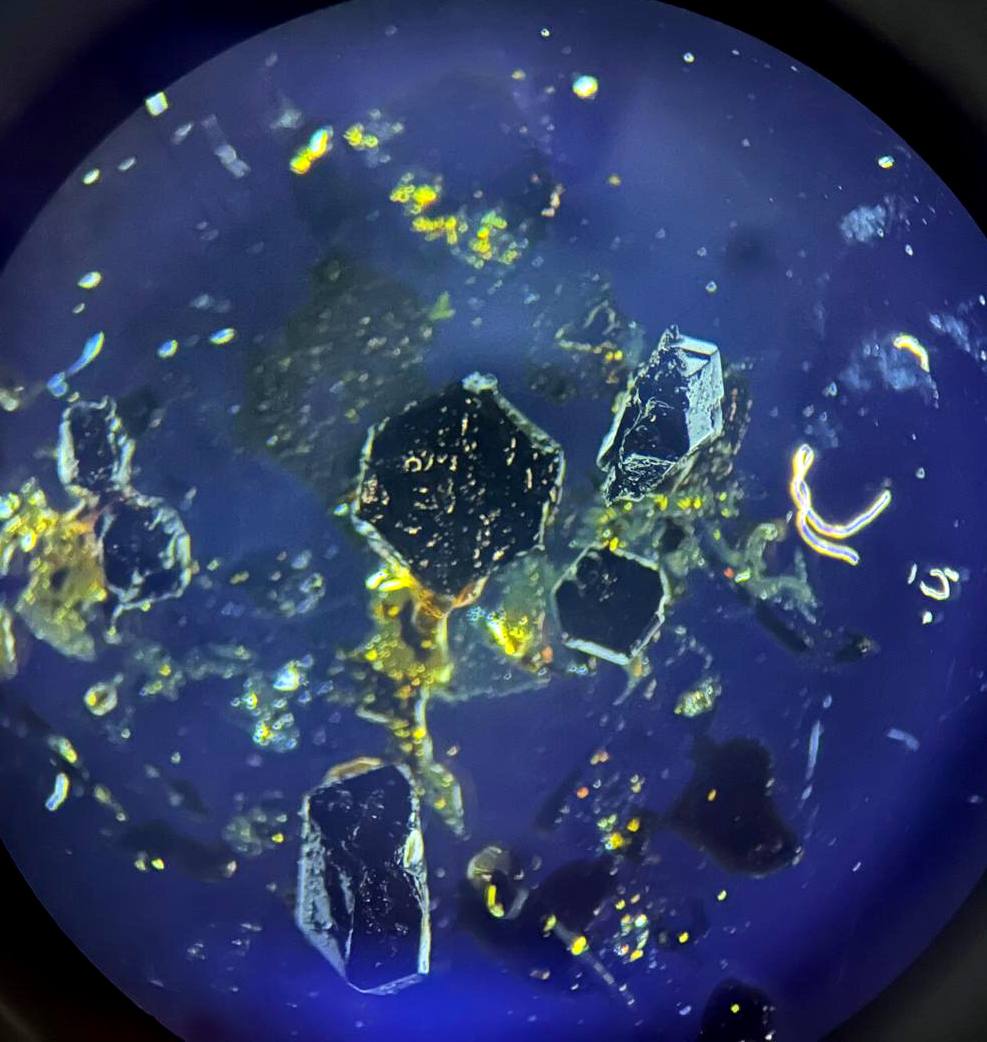
Metal atom cluster compounds are coordination complexes that contain at least two metal atoms linked via strong metal-metal bonds. They feature metal centers in low oxidation states and are coordinated to ligands. In our research group, Zr, Hf, Nb, and Ta clusters are investigated. These clusters typically contain metal atom octahedra whose ligands can be substituted with other ligands via solution-state chemical reactions. This provides access to cluster compounds with a wide variety of interesting properties.
By selecting a diverse range of neutral or anionic ligands, a vast array of metal atom cluster compounds can be synthesized, featuring isolated, discrete cluster units, as well as one-, two-, or three-dimensionally interconnected frameworks. These compounds exhibit distinct colors. For example, linking these units through other metal atoms yields porous cluster polymers (MOFs). The introduction of chelating ligands results in highly stable cluster entities. Notably, Na₆ and Ta₆ clusters with alkoxide ligands were synthesized and investigated for the first time within our research group.
Metal-Containing Ionic Liquids
Ionic liquids (ILs), defined as salts with a melting point below 100 °C, are characterized by their unique properties. In particular, their low vapor pressure as well as high thermal and electrochemical stability are of great interest. Metal-containing ionic liquids incorporate a metal complex anion or cation, distinguishing them from conventional organic ionic liquids. This allows for the development of, for example, paramagnetic properties. In our research group, novel metal-containing ionic liquids are synthesized and investigated for application in critical technologies, such as battery systems.
Tetracyanidoborates
Tetracyanidoborates (or tetracyanoborates) are salts containing the tetrahedral \([\mathrm{B(CN)_4}]^-\) anion. This anion is characterized by its unusual size and high stability, which renders it chemically inert and thermally robust. It belongs to the class of weakly coordinating anions, making it an excellent partner for the stabilization of unusual cations. Furthermore, these compounds exhibit a very high electrochemical stability.
In our research group, new tetracyanidoborates with a wide variety of cations are synthesized and investigated, many of which possess unique properties.